Wednesday, 14 May 2014

Brave New World(view)s


I felt like I had stepped back into my academic past when my friend invited me to participate in a docent tour for the latest exhibiton at the Metropolitan Museum, "Brave New Worlds: My Utopia in Your Dystopia". During the tour, mention was made of Shakespeare, Chomsky, and post-modernism, and our learner tour guide was a fresh-faced graduate with great enthusiasm for the works and a head full of information. Rather disappointingly for me, it was a struggle to retrieve much of any relevance from my memory banks and I had to repress a strong urge  (until I got home) to whip out my smartphone and do some quick fact-checking.

The blue creatures depicted on the exhibition banner at the entrance to the museum looked very familiar and I wondered if they resembled the etchings I had once seen at another gallery and from an earlier century? Or were they representations of those underground creatures from that book by H.G. Wells (i.e. the Morlocks in "The Time Machine")? It turned out to be neither, and they were instead, an artist's rendition of his family members. For once, I am thankful that our family has no artists. Do they remind anyone else of anything in particular?

The curator of the exhibition has explained his concept of the "Brave New Worlds" by saying that, "in this millenium, we are faced with cataclysmic decline of the environment and societies, and artists have dealt or anticipated this world on the verge of collapse". The objects on display were a diverse range of mediums: textiles, digital, aluminium, paper, wood and our guide shared the artists' visions with us, which was quite necessary. I like to believe I have a positive view of the world and coupled with the fact that I am not really an activist, I need that starting point to appreciate them properly (just like Catherine Martin does apparently. I had never heard of her until I caught this interview on Australian Network today, but she has won four Oscars  for costume and design in films. I found her world view fascinating and she spoke about her own starting point with candour).

Returning to the tour, several of the works were a little on the sensational side or involved scenes that are confronting to view, and I found myself suddenly blurting out mid-tour, "It is just not nice at all" after the group had been asked how they liked a certain installation. Fortunately my outburst did not impugn my host country's national honour as the artist was Australian, but I was surprised that viewing this particular work evoked such a violent reaction from me. Surprised and exhilarated. Our guide was kind enough to expound on the rise in recent years of "statementism" (is that the name of a movement already? or do people still talk about making political statements with their art?). I was provoked to think about a specific issue but I am not sure I am better off for it. I will return next week with my friend and attend a curator/artist talk, so will update you if my view changes at all.

What was really cool about this museum visit was that the Director joined the tour and described how certain art works had been assembled in situ. One big aluminium wall was welded together inside the hall and will have to be dismantled after the show is over. Another piece involving a dumpster was created by the artist on site using locally sourced materials. And there is another piece yet to be installed after the French artist arrives next week.

I found myself looking at my neighbourhood in a different light as I walked home.


Tuesday, 6 May 2014

All at sea


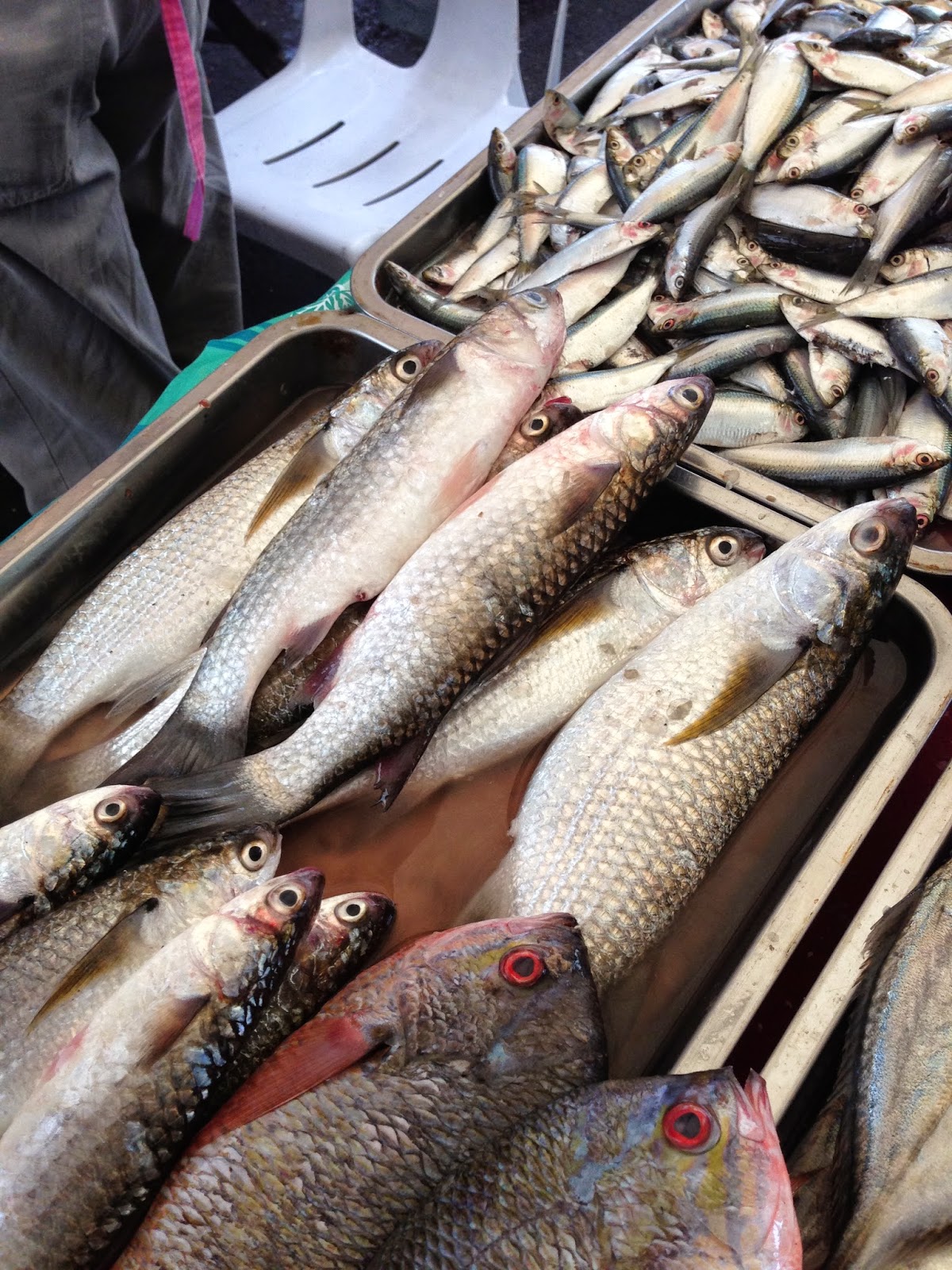
Last Sunday I bought a fish (see picture to the left) at my local market for my husband who grew up on the coast and who would eat fish every day of the week if he could, whereas I on the other hand, grew up in the Australian bush* where eating fish and chips or fish fingers** was pretty much the extent of my seafood diet, and consequently. I can take it or leave it, but because I love him, I buy him fish (how unromantic is that?).

This time I remembered to record an image and make a note of its name while I was still at the market because based on previous experience, I knew the Tagalog name would disappear from my memory banks during my walk home if I did not. According to the vendor, I had purchased a banak, a deep sea fish from Palawan (Php300/kilo). Later through a search on the Internet I determined it was a sea bream. 

I do not recognise this fish at all, and I don't think it is available in Japan but even though I have learned more about Japanese fish since I was a newly-wed and felt squeamish looking a fish in the eye (and I am proud that I can at least recognise shake, karei, saba, sanma, buri, suzuki, maguro now) there are many that stump me, and I would not be surprised if someone told me, "that is X, you know". It may even be a fish that my Abrolhos Island diver friends would be familiar with.


The week before I had bought this mystery fish (to the right) and even though I conscientiously repeated the name several times and I even had a witness with me who turned out to be totally unreliable, afterward I could not for the life of me recall what it was named. I believe it begins with the letter K but have had had no luck finding online any Filipino fish with a K initial. I even tried Google image search which initially showed me a lot of pictures of cake until I entered the word fish in the search box. Then it just showed me other fish but none were the same colour even. Think Google needs to sharpen its search skills somewhat if it wants my repeat business. 

I really would love to know the name because this fish was quite tasty and only had a medium-amount of bones. Many fish found in the Philippines have more bones than the fish eaten in Japan, which makes them less fun to eat. I steamed it in a saucepan with sinigang soup which is made from tamarind and has a sour taste (see here for a recipe, but I must confess I used a supermarket packet). 

Now if I were in the blog business, I would offer an awesome prize such as a week-long holiday diving at one of the top 10 dive destinations in the Philippines but since I am just a regular Joe(di)-blow, all I can offer is my gratitude. Please could someone identify this fish for me and put me out of my misery? I hate being all at sea...

UPDATE: We have a winner, scroll down for the answer ***


   * rural town but not the desert
  ** known also as fish sticks
*** kitang

Thursday, 27 March 2014

Visions on a Sunday in Antipolo


Desirous of a change of scenery, we rented a little taxi (seen to the left) and escaped Makati by heading east for Antipolo city, which because it is perched atop the elevated slopes of the Sierra Madre mountain range is cooler than Manila (check here for a map). We were surprised how quickly the terrain transformed into highlands after we exited the city. The photograph below shows where we stopped en route to take in the view of Ortigas. I am not sure what the height of the land here is above sea level and we may have still been technically in hill territory, but shortly after we departed this look-out area, the road gradient steepened and the countryside steadily became more mountainous. 


What was also noticeable was a large number of churches, cemeteries and quarries. A very hol-y place indeed! 

Our itinerary was meticulously planned; as in, based on my recollection of a friend mentioning a visit to an art gallery in Antipolo several years ago, I did a web search to locate it, and then I pushed my luck further and searched for other sightseeing spots in Antipolo to round out the day and came across the names of a waterfall and an old church. 

I carefully copied the names of all three destinations on my hotel stationery so I could show them to Nito, our taxi driver. We met Nito several weeks earlier when he had taken us to the practice golf range on the Villamor Airforce Base, and had learned at that time that he worked weekdays for a Japanese furniture company and drove a taxi on the weekends as his second job. Armed with his cell phone number as a backup, we requested his services for our Sunday drive. The waterfall seemed a good place to commence the day's activities, but when I spotted the sign for the Pinto Art Gallery while Nito was seeking directions, I  decided it was wiser to alter the itinerary order.


The Pinto Art Gallery, which is within the Silangan Gardens, is located in a regular residential subdivision. The entrance to the gallery was not immediately obvious and when the first door I tried was firmly locked, my heart sank and I thought, "Oh, no, have I been caught out again by internet misinformation?" But then all was well, as we discovered the entrance hiding to the side. Inside the walls, a very spacious and verdant garden dotted with white buildings revealed itself.  We received a map and set forth to explore. The gardens were delightful and the art was original and provocative.                 


I wondered who was responsible for creating such a lovely fusion of creative pieces with nature. There was a plaque on the front wall with a list of names which led me to speculate that perhaps it was a cooperative run by artists, although it looked more like the home of a wealthy family. Post-visit I returned to the internet to search for some answers. It turns out that the Silangan Gardens are the summer home of Doctor Joven Cuanang who is a neurologist associated with St Luke's Medical Center and an art patron (see here for more). He established the Silangan Foundation for the Arts, Culture and Ecology, which is devoted to Philippine Contemporary Art, and is its current Chairman and President. 


It was a tranquil and peaceful place to spend an hour. We would have liked to have lingered over merienda (morning tea) and enjoyed the charming scenery longer but the cafe was emphatically closed, and without an excuse to dally, we withdrew. Please see here for more details about Pinto Gallery on its homepage. 

The Hinulugang taktak (waterfall) was next on my list. We found it easily enough but sadly, it was closed to the public for repairs. A friend of mine told me that the falls dried up a few years ago and the works have been "ongoing" for some time now. 


Lastly was the Boso Boso Church. I chose for us to visit the church over the local cathedral despite the fancy dome being home to a 17th century wooden statue of Mary because the church was said to have been built in 1700 and was part of the original settlement of Antipolo. There was mention that parts of it had been destroyed and re-built at various times in its history, but the descriptions I encountered made it seem like an interesting place to see. (Post-visit: I read that it is believed by some people that author Jose Rizal mentioned this church in his seditious novel, "El Filibusterismo").

This is where being a tourist in an unfamiliar environment can be equally a hindrance and a help. It was really quite far to the church from the waterfall. Nito did a good job to find it at all. I had my doubts. The little taxi's engine bravely whirred as it ascended and the rocking motion sent one of the backseat passengers to sleep. I gazed out onto green expanse after green expanse, church after cemetery after church, and our fellow journeymen on the road, the jeepneys. I had no idea how long it would take to reach our destination, and knew that I would probably not receive any elucidation should I attempt to put the question to Nito for it was clear to me that it was his first visit to the region.

It probably took about an hour to arrive at the church, and Nito's face visibly fell when he saw the desolate church (see above photographs)  and my husband jovially enquired, "Don't you know this church? It is very important to Filipino people ". In retrospect, I do wish I had known about the Rizal connection so I could have reassured him about the worth of a visit to such a remote area. 

The plaque screwed on the front of the church stated that it had first been erected by Jesuit priests in 1700 as a mission church. Geographically, I could not pinpoint the logic behind the choice of locale. I could not see a river near by, nor was it on a high point with logistical advantage. The church has been extensively re-built over time and I could not distinguish any original materials amongst the hollow concrete bricks. And unfortunately, any written records of this kind of history have been either lost to mould, or have been lost to the dust of academia. Other than the couple who were selling pineapples at the church gate, the sole praying parishioner, and the two boys who walked through the courtyard, there were eerily, very few people around. 

Thus, it is a help sometimes not to know the complete details, otherwise I may have struck the church off our impromptu tour and headed back to the malls of Makati early, heathen that I am. Which means what? I would not be able to laugh with my husband about the trip we took to such a famous historical landmark. "It's research!" he insisted. Yes, well perhaps it is. More importantly, it was just the change in scenery we had been hankering after in the a.m. and which had prompted the urge to take a Sunday trip out of town in the first place.


Wednesday, 19 March 2014

An eye-catching Greenbelt experience


Lushly green, this shopping mall is appropriately named, "Greenbelt". It is toted as the premier shopping destination in the Philippines on Wikipedia and I can attest to the validity of this claim as it truly does come complete with a raft of restaurants, high-end fashion shops, cinemas, and an open-air chapel. It possesses a dynamic, almost throbbingly alive atmosphere and we have found ourselves soaking in its vibrancy while listening to live music more than once or twice on a Saturday night. During the week, I will often meet a friend at a coffee shop overlooking the pond where two turtles live.

Counting the number of global stores that have hung a shingle here, you could be forgiven for thinking it is a generic mall but the incorporation of the outdoors into the design makes it unlike shopping centres I have experienced anywhere else we have resided. It does become a sticky steam bath during the rainy season and you are likely to be hit with fat drops of water as you scurry between covered areas, but nonetheless, it remains a unique space in a city where urban sprawl is fast spreading its tentacles and choking any greenery in its path. When we arrived in Makati for the first time in February 2001, there was only Greenbelt 1, which multiplied relatively quickly in the following years to become Greenbelt 2, 3, 4, and 5.

The origins of the mall also reflect the history of the Philippines as it was developed and is managed by the real estate arm of Ayala Corporation. This is a family business established in 1834 which has diversified to the extent that its services reach into every home in some shape or form. The list is long, but I will include it for demonstrative purposes: real estate development, banking and financial services, telecommunications, water distribution infrastructure, electronics manufacturing services, automotive dealership, overseas real estate investments, business process outsourcing, renewable energy and power. One of the company's most visible accomplishments is the development of the Makati to become the central business district of Manila and a residential hub. The family traces its roots in the Philippines back to the 18th century when their forebears immigrated here from Germany and Spain (the Spanish side of the family has aristocratic links). Please see here if you are interested to learn more . Needless to say, this family is a prime force in the affairs of the country.

Coincidentally this week, while by day I was navigating the complexity of this modern mall with its labyrinthine floors and connecting escalators, by night, I was being transported back to a simpler time, courtesy of a book I had started reading entitled, "The Women in Black" by Madeline St. John. It was set in the Sydney of the late 1950s in a department store during an era when women would do all their shopping in the one department store and their clothing purchases were altered to fit them. As someone who has spent more than my fair share of hours within change-room confines, there is a part of me that laments the loss of such all-encompassing institutions. My grandmother used to make special shopping forays to Melbourne around the same time of the book's milieu and was said to have had, "really beautiful clothes", and I could almost imagine her walking through the doors and placing her order with one of the characters vividly depicted in St. John's novel. I was also struck by the fact that the author herself was an expat and wrote the book while she was living in London.

Is it distance that focuses the eye, I wonder? This return to Makati I am forcing myself to look anew at my surroundings, which quite often means shop buildings and street pavements. I am aware that it only takes a few short shuffles past a place before familiarity fades the seen into unseen. Life is too short for everything to become predictable too soon so I am hoping my third eye will allow me to experience a new world full of curiosities and awe during this next stay. I wish I could peer into the future, but since I cannot, it is a case again of having to wait to see what the future holds.........................???


Wednesday, 11 December 2013

The Story of Seikosha i.e. the "House of Exquisite Workmanship"

19th century swinging clock
I spend a substantial amount of time studying maps and seeking out scenic sights for us to visit on our weekends so it was a pleasant surprise when, without any fanfare, the Seiko Museum showed up on my radar one day. Better still, it turned out to be almost in our back yard. I was startled that Seiko had established their museum in a nearby, nondescript neighbourhood in Sumida ward but whatever the reason was for their decision, it was positive for us, as it meant that we were only a thirty-minute bicycle ride from its doors.

The Seiko Museum has an impressive collection of early timepieces. Some of the pieces had interesting forms (see the 16th century English sun dial to the left), others were beautifully crafted (see the early 19th century pocket-timepiece to the right), or served as a teaching tool (see early 17th century model of Shumi-sen below, the sacred mountain for Buddhists which they believed at the time to be the figurative centre of the universe). Additionally, there were a number of very large upright clocks from various countries and even a model replica of the Big Ben inner workings.

The museum allows photography of all of its exhibits except for this one model (the photograph below left is one of a postcard I bought from the gift shop), I had never seen one before and it piqued my curiosity. I was told it was used to defend the Buddhist belief of geocentrism after the emergence of the new Copernican theory led to attempts to discredit this belief, and by proxy, the Buddhism way of thinking as a whole. A little research later and I unearthed the fact that Shumi-sen is alternatively known as Sumeru (Mount Meru) and is a sacred mountain in Hindhu and Jain cosmology also. Can you see the hourglass shape on top of the table which represents the mountain?

I liked how the museum built on the development of time-keeping devices throughout the ages to place its own products in historical context. The first wristwatch, called the "Laurel" was produced in Japan in 1913 but the Seiko story began considerably earlier than that. It is a fabulous story of hard work and persistance by a man with a remarkable character.

Kintaro Hattori was born in Kyobashi, Tokyo (which is near Ginza) in 1860 and was apprenticed out at the tender age of eleven. He spotted a niche in the market and established his first shop for selling and repairing clocks when he was 21 years old. He first began buying imported clocks from the foreign trading houses in Yokohama before he went on to open his own clock and watch factory.

It took fifteen years before his watch line of business turned a profit but he was determined to produce accurate and high-quality watches and did not give up. The introduction of automated machinery (see right) in 1910 helped move him out of the red and his foresight to stockpile materials prior to World War One consolidated his position when shortages hampered his rivals' activities.

When I found out that the Ginza Wako building (see picture upper left) was completed by my engineer-husband's company in 1932, I felt thrilled to have a semi-personal connection with Hattori's success. I also like one of his mottos, "No hurry or rest". He seemed to have balance on his mind in all things. I started to understand my husband's appreciation of the product and to appreciate anew my own watch, which I received from him when I was a newly-wed and we were still living in Nagoya.

I saw this newspaper advertisement (on the left) from 1938.

The museum also had a section devoted to its sport timers and participation in various Olympics starting from the 1964 Tokyo Games. Seiko watches have also had the honour of being worn by astronauts and James Bond.

And lastly, not that I am a Bond girl, but I quite liked this watch from the sixties (see below).


I notice that I neglected to take any photographs of the inner workings of the watches, and I completely overlooked the world's first solar GPS watch released last year. I have been quite negligent - if you would like to know anything about the mechanical side of clocks, the best I can do is suggest you ask my husband. He is the true fan in our family. Here is one more photo of the most current watch that caught my eye. Does that mean I am stuck in the nineties? No never, I prefer to think it is a classic watch, it's a Seiko after all.


Tuesday, 3 December 2013

The Power of Ordinary People


Arriving at the above golden splendour was an unexpected delight during a visit to my homestay family in Saitama prefecture over the weekend. The Shodensan temple in the town of Menuma is hidden smack bang in the middle of farming land, and the surrounding flat fields with their cultivated rows of leeks (see picture on right) and nearby farmhouses looked way too quiet to have such an ornate temple sheltering in its midst. Otosan (my host father), who has resided all of his eighty-six years in a town less than twenty kilometres away, mentioned several times that this was his first time to visit the area. Part of the reason Shodensan temple has attracted little attention during Otosan's lifetime is because its gaudy, glittering facade only re-emerged in the twenty-first century. For many years, the intricate wooden carvings had been untended and time had chipped away the wooden surface, causing the paint to crack and flake. Their condition deteriorated to a perilous state when barely in the nick of time restoration efforts commenced. 

After seven years and 1.3 billion yen (which is more than 13 million in AUD), the overhaul was complete in 2011. The project was funded with money allocated by the government and with donations from the private sector. I can imagine there was a group of ardently concerned citizens who advocated for these repairs to be undertaken. Their hard work was rewarded as it was designated a kokuho (National Treasure) by the Japanese government the following year. This status is given to items with special historical or artistic significance and will ensure the temple is well-looked after in perpetuity (see here for more about). There is also a news article here which explains in more detail about the restoration processes.


That the temple was rescued through grass-roots efforts also seems quite appropriate as I discovered that the building of the temple had originally been sponsored piecemeal with contributions from the local people over a quarter of a century period from 1735 until its final completion in 1760. An earlier structure had been destroyed in a fire in 1670. And the actual site itself has been in use as a temple from an even earlier era as it was established by a military leader called Saito Sanemori in 1179. It is quite amazing to be in a place that has served a sacred function for more than eight hundred years.

When we drew near to the temple, there was a volunteer guide explaining the symbolism of the different carvings. The fine craftsmanship and detail of the carvings immediately stands out as worthy of high praise indeed. These works were conducted by artisans who may well have honed their skills first on the very famous temples of Nikko which are just a hop, skip and a jump away. I was finding it very interesting to look at artworks that convey a narrative (rare in Japanese temples) when the guide surprised me by referring to foreigners in her spiel. Apparently when she informs foreigners, "It's gold." they respond, "I want it!". I was the only foreigner in the crowd and I don't think she noticed me in the crowd. Not sure why she felt this was worth mentioning twice. My best conclusion is that she was proud to be the custodian of such precious objects and this is how she conveys its value. It was certainly weird to witness her recounting it to her fellow country people. 

I could not really follow her explantion and while I noticed she spent considerable time discussing some carvings of elephants, the significance did not really register until I was doing some Internet fact-checking later. This is when I read that the temple was founded by an escoteric Buddhist Shingon-sect and is dedicated to the guardian god Kangi Jizaiten who has a human body with an elephant head (although I did not see him in this form at Menuma, only the regular elephants).  "Oh, it's Ganesh" I exclaimed to myself. He is familiar to me from my time in Poona, India where I saw many representations of him. I never knew he was a cross-over god with a Japanese strand to his story. In India we had seen a giant Buddha statue in the Ellora Caves from the 12 century, and it was intriguing to now be in Japan and see where a Hindu god has been adopted into the local pantheon. 

This is what I like so much about history (and religion, too). How the separate strands overlap and combine in such disparate scenarios. How old customs and rituals reinvent themselves anew. And how our personal stories help us to make sense of our place in our surroundings.


Sunday, 24 November 2013

135,800

That is the vast number of people, including the lucky two of us, who attended the first day of the 43rd Tokyo Motor Show. Inside the building the crowd thronged with revheads lugging their oversized cameras and tripods around. The massive crowd (and the girls) almost obscured the cars and turned getting a clear view into a test of both perserverance and endurance.


Having observed the Tokyo Motor Show on the news over the years, it was a great opportunity to experience what all the fuss is about. I was impressed by the tremendous number of vehicles on display simultaneously in one location; and if we were in the market for a new car this would be the place to be. Engineer husband was a little disappointed about the lack of innovation and felt that shift away from the tired, old four-wheel design is long overdue, but as anyone who knows me can attest, I am not into cars and I was unfazed by the lack of variety in the lineup.

However, true to form, I did find the venue, the Tokyo Big Sight in Odaiba (i.e. the nickname for the Tokyo International Convention Center) itself to be quite fascinating. According to Wikipedia, this is where the wrestling, fencing and taekwando events will be held at the 2020 Olympic games and it will also serve as the main broadcasting centre and press centre. For those who would like a better sense of its locale, here is a Google Map.

From the outside, it has an imposing form which demands your attention, and from the inside, it is a maze of different levels (which again, demands attentiveness). I took the below photograph of the main entrance below as we were leaving. The stream of people leads to the entrance at the far right.


If you are a person who likes a map here is a building map. Our route for the day entailed us entering the building from the east wing (bottom left photograph) as we had ridden our bicycles and ended up here rather than at the main entry point. Research after the fact uncovered that this wing had been built by husband's company in 1996 with the opposite west wing being built by a different contractor. Once inside I lost all sense of direction and followed the flow of the crowd. After we saw the east wing exhibits, we walked through a connecting passage to the west wing and checked out more displays. To escape exit we ascended to the fourth floor (below right photograph) where there was a viewing platform and the surrounding buildings looked close enough to touch before we found the outside staircases and our way out.


Phew, relief to be outside again and surrounded by open space. Quite happy to hop on my bicycle and cycle home as the sun commenced its descent. Although it would be dark by the time we covered the 16 kilometres distance. Perhaps a car could be a good idea after all? No, I'm just kidding, you knew that, didn't you? I can't imagine when we will ever own a car again. In the meantime, we love our bicycles, especially on glorious autumn days like this one was, and are quite content to rely on pedal power to the nth.

Thursday, 21 November 2013

Japan Folk Crafts Museum, Komaba, Tokyo


A sunny bright blue sky made my trek with a friend to Komaba to visit the Japan Folk Crafts Museum the other day very pleasant indeed. Autumn is the prescribed season for artistic viewing events in Japan precisely because of such wonderful days. And it was bliss to be outside in the sun's warm rays on an especially perfect day.

You can see the entrance to the museum in the photograph to the left. It was not simply what was inside these walls which had attracted me here. The museum was built in 1936 by Soetsu Yanagi who was closely involved in its design. Carpenters were brought from Tochigi to carry out the fine craftsmanship and once inside it was clear that a great, great deal of attention had been paid to every detail. The photo at the top right shows the benches placed in every room atop wooden floorboards and a customised display case in the background.

Our timing was also fortunate as the Yanagi residence (below left) across the road was open to the public. This home was delightfully quaint with its tatami-mat rooms and a book-lined library. The entrance floor was lined with stone (below right) which was beautiful albeit rather chilly. This is one museum which would make an ideal summer oasis. Despite the decidedly cool indoor temperatures, there were quite a few fellow attendees, all eager to pay homage on the second-last day of the exhibition.


The museum was displaying various items from the collection of Sori Yanagi, the son of Soetsu Yanagi. While the father was a philosopher who fostered an appreciation of the folk arts through the establishment of the museum, his son was an industrial designer, and later, the third curator of the museum. In my limited experience, it is rare for individual collectors to occupy prominent public positions in Japan and my eye had been caught by the title of the exhibition: "Eyes of Sori Yanagi". 

The items being presented had been compiled from his personal much-loved collection to give people a glimpse of the objects he had sought out during travels to Africa and West Asia and which had inspired him in his own works. The pamphlet prepared by the museum explained they had chosen not to add any explanation to the items in order for people to focus on the innate beauty of the objects. For devotees of Yanagi's designs there was probably no need for any elucidation but for myself, I was thankful I had briefly researched the man prior. Aside from his success as a designer, I was curious how his name, "Satoshi" morphed into his nickname "Sori". Did he apologise one too many times and end up with a new moniker perhaps? 

My search was unsuccessful and I put that mystery aside and instead concentrated upon pictures of his famous kettle (see here) which looked instantly familiar to me. His other revolutionary design was the butterfly stool (see here) which is now part of the MoMA collection in New York and available for only USD725. No doubt it would make someone a lovely Christmas gift.

Moving around the galleries, I gazed intently at the items to find the connection between them and his designs, and felt like I had come up with an original design myself each time I felt I discerned a creative link. I felt snobbishly gratified that his textile collection included a number of  kantha (running stitch) quilts from India (maybe Bangladesh now) which were like the one I have. Also he had a fascination with African masks, some of which were massive. Quite different in scale from the kind of souvenirs I can fit into my suitcase when I travel. My friend and I surmised he would have shipped these home. With the museum just across the road from his home, he would have had plenty of storage space. Looking at these items it was quite amazing to think they had fed his creative juices and in turn, he was inspired to re-create their form anew. 

After contenting myself with a few postcards from the gift shop and several photographs from the footpath, we departed. I headed home feeling enriched from my short sojourn with Sori Yanagi. Although, if they had been selling bottles of whatever it was that Sori Yanagi imbibed with his meals, I may have been a little more extravagant with my purchases. Maybe travel was his magic elixir, but wouldn't it be something if we could just drink in new ideas with a tonic every day? (non-alcoholic, I mean, of course).


Monday, 11 November 2013

Autumn life cycling


Gunning our engines in front of our apartment block, we are on the verge of riding our bicycles to our local shopping centre for a very ordinary Sunday afternoon of shopping here. I thought perhaps I would like to browse for a new pair of gloves now that the weather has taken a turn for the cooler. The jackets shown in the photographs were not really essential when we set out as it was a warmish 15 degrees Celsius. The days are shortening however and when the sky begins to darken, which is around 4:45pm these days, a coat becomes much appreciated.

I try not to talk about our bikes when I am speaking English because then I slip up and use the same word when I am speaking with Japanese speakers and a "bike" in Japanese is a motorbike, and from there the conversation spirals into chaos and confusion. Of course, I could just use the Japanese word, "jitensha" but that somehow does not slide off the tongue as easily. 

Despite the slippery semantics, we do love our bicycles because they help us make trips to the shops without too much fuss. In fact, we discovered the existence of an impressively large shopping complex close to us (and our destination on Sunday) during one of our early reconnaissance missions. Without our bicycles, by foot it would take thirty minutes to walk there, or we would have to catch a not-so regular bus and as this would require advance planning, it would probably never happen. 

We have even ridden to the local golf driving range on them as we have a golf bag with shoulder straps. Only ever side-swiped an electricity pole once, thankfully managed to miss all living obstacles met along our path (so far). After living in places where moving around is difficult due to high levels of traffic, it has been a joy to regain our mobility independence. Tokyo is also a city of layers and viewing it from the street reveals much of its character.

We are not alone in being crazy about our machines as when I returned to Tokyo this year, I noticed many more bicycles on the footpaths compared to past periods when I have lived in Japan. After the Tohoku earthquake and tsunami in 2011, many people were scared and they switched to using bicycles for their personal transportation because these are a reliable form of transportion during emergencies. Due to the increase in the number and age of cyclists, there are even special bicycle accident insurance policies for elderly people available. Although in my opinion the more dangerous cyclists tend to be the younger women who ride against traffic i.e. in my way. I was advised that visualising them splattered with a paint-ball was one way to reduce any feelings of frustration, and I can report it is an effective ploy.

Leaving my bicycle unchained anywhere in public is also risky as theft is rife. There is something about the cycling world that lets loose an avalanche of unlawful acts by its inhabitants. This occurs in sharp contrast to most other spheres of society where rules are upheld as golden. The registration system for bicycles does not seem to deter certain elements. The police do sometimes check for proof of possession and when I gave away my older bicycle through freecycle earlier in the year, I had to draw up papers to transfer ownership to ensure the new owner would not encounter any problems. 

Our shopping centre (mall) was packed with masses of people who all had the same idea to escape inside from the gloomy overcast sky outdoors. The bustling crowds reminded us of the Glorietta mall in Makati city in the Philippines. Engineer husband's last project in Northern Luzon was to build a weather radar tower which was funded with a low interest yen-loan. 

It is gratifying to think his work had contributed in a small way to the Philippines receiving some advance warning of the arrival of the super typhoon Yolanda / Haiyan. The devastation seen through media such as YouTube is reminiscent of the 2011 tsunami in Japan however and the scale of the typhoon means that merely receiving advance warning was never going to be enough to save everyone. It is truly sad. As a friend who is living in Manila commented, "there seems to be one universal truth whenever something like this happens, it's the poor who suffer the most." 

I never found the gloves I wanted. But I am thankful for a stable and safe life. Life goes on as usual for the time being. And that is wonderful!


Monday, 28 October 2013

Searching for a Swordsman

I am always looking for new places for us to visit and explore, and at my local train station recently, I chanced upon a flyer promoting the railway company's 67th annual Sawayaka (refreshing /crisp air) walk. The scheduling of this kind of event is a cultural marker that autumn has arrived in Japan, as it is the season when at long last after the draining humidity of summer, the temperatures abate, the air crispens, and spending time outdoors becomes pleasurable again. We resolved to join the hordes in this group activity mainly because the walking course outlined took in a temple in a teramachi (temple town) boasting of an intriguing connection to Miyamoto Musashi, author of "The Book of Five Rings". Musashi Miyamoto was a famous swordsman born in the late sixteenth century, who was undefeated in more than sixty sword fights before he was thirty years of age. His advice, despite being somewhat on the dry side in my opinion, is well-regarded by the business and management industry. 

In preparation the night before the walk, I pulled my unread copy of this book off my shelf which I have had for some years now with its back cover proclaiming that it, "provid[es] the tools and wisdom necessary for success in any human endeavor" to see if I could find out more about this supposed connection with a temple in Chiba. Sadly, the walk was cancelled when Typhoon No. 27 (international name: Francisco) decided to grace Japan with its presence and clashed with our plans as it brought with it steady rain to the Tokyo region instead of sawayaka breezes. Generally the capital bears much less of the brunt of the force of a typhoon than other regions of Japan, and once again this was true with only medium-strength rain falling and not much wind so that rather than causing any damage in our immediate proximity, it merely put a dampener on our plans.

But not for long as post-typhoon Sunday dawned and the sky was a brilliant and clear bright blue. We went ahead and set out for the teramachi by ourselves. We crossed several rivers and left Tokyo behind us for Chiba prefecture. Chiba has a different vibe than Tokyo and it feels like being transported to the countryside. The blue skies were amazing and the sunshine warmed our spirits. Of course, I did ride my bicycle around in a circle (of which I was totally unaware) and grew a little heated without any outside help prior when access to the river bank eluded me for a short while, before we triumphantly reached our goal, Tokugan-ji temple. We were the only visitors, apart from one woman who was carrying a water pail on her way out after obviously tending to a family gravesite. Nice to have the place to ourselves and take photographs of an unimpeded temple. That doesn't happen often in Japan.


The gate to this temple (see picture above) was built in 1745, which as Musashi Miyamoto died a century earlier, makes the connection between the two of them unclear. We were surprised by how new-looking the structure was. It has been well-maintained despite being situated on a low-lying plot of land. Mr Engineer noticed signs of flooding in various sections, most worryingly around the grave markers at the rear. We hunted fruitlessly for any information about Miyamoto Musashi linking him to the temple. What is on the public record about him is that he was famous for his fighting skills in his early years and for his philosophical and writing skills in his later years. Less well-known is that he was also a talented sumi-e artist and painted the lovely work with the prosaic title, "Shrike on a Dead Branch" seen to the right. Sumi-e is brush-painting using ink ground from an ink-stick, various brushes made using hair from a wide range of animals and different paper textures. It requires many years of training and practise to master and is an extremely difficult art form to perfect as the artist cannot erase any strokes once they start. He must have been a patient man, as well as a great warrior.
              
After a little internet digging it seems that perhaps NHK TV filmed scenes at Tokugan-ji for its Taiga drama (year-long historical fiction series) but I cannot tell if it was a past or future production. I may need to do some additional research and watch some TV. You can read more about Miyamoto Musashi here. He lived to be over sixty years which is quite remarkable considering his vintage and his dangerous profession. Despite some disappointment felt for not finding out more about the legendary man, we derived great satisfaction from simply walking around the ageless buildings, and I wondered to myself whose footprints we were re-tracing so many years later.